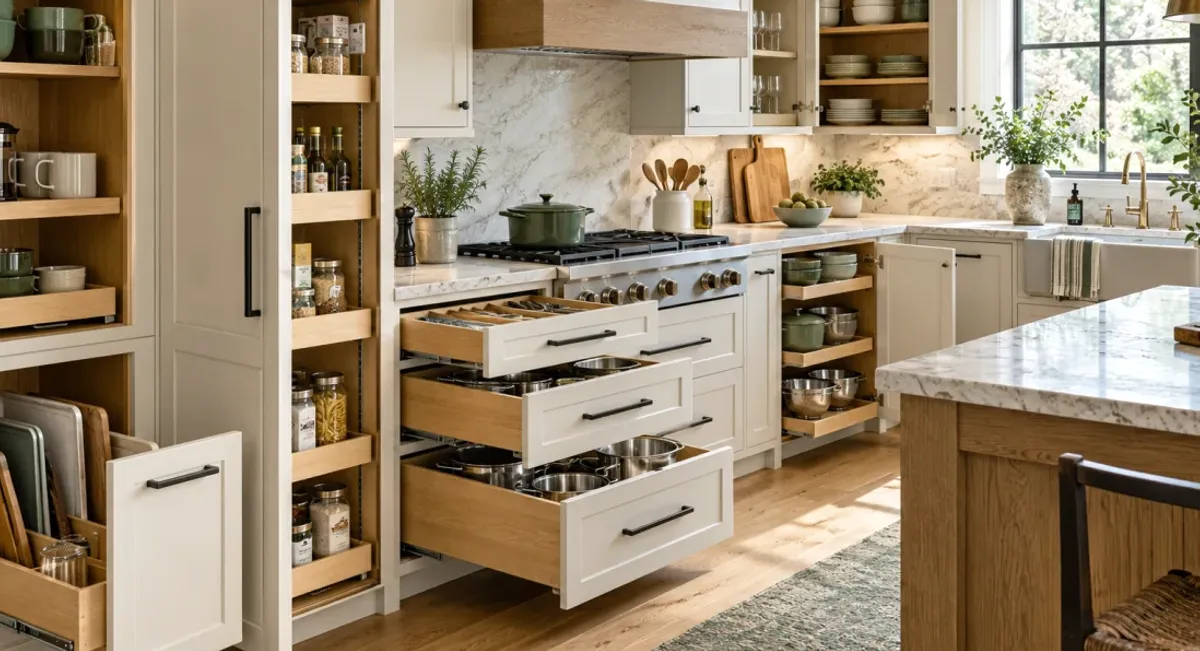
A tall pantry is a heavy cabinet with a high center of weight. Loaded with cans, small appliances, and shelves of dishes, it can tip if it is only sitting on the floor or only screwed into drywall. In San Diego County that risk is not theoretical. Houses move. The pantry should be fastened in a way the remodeler can explain, to structure they have actually found.
Modern Kitchen San Diego does not install cabinets and does not design a seismic detail. You contract with an independent remodeler. If the fastening is a structural question beyond their license, they should bring in the right engineer. This page does not cite a code section and it does not give a screw schedule. Those belong to the people signing the work.
Why a tall box is different from a wall cabinet
A wall cabinet is short, and it is screwed along a rail into studs or into blocking. A tall pantry runs from the floor to near the ceiling. It may be one box or a stack: a base, a set of doors, and upper doors on the same face. The floor carries the weight on a normal day. In a shake, the top wants to walk away from the wall. If the top is loose, the box can rotate and fall into the room.
Depth makes it worse. A pantry deeper than the base cabinets beside it is easier to tip. So is a pantry on pull-out shelves full of food. The empty cabinet in the showroom is not the weight you live with. If someone proposes a tall unit that does not touch a stud wall, ask what holds the top before you accept the look.
Ask how it fastens to studs
The question to ask, in plain words, is: what does the fastener bite, and how do you know?
A screw that stops in drywall, in plaster with no lath hold, or in a thin cabinet back is not an anchor. The remodeler should find studs, or add blocking while the wall is open, and fasten the cabinet into that wood or steel. They should be able to say where those fasteners land: near the top, at a hanging rail, through a solid stretcher, or through the back at a stud line. “A few screws in the back” is not an answer until they say what is behind the back.
Ask to see it before the backsplash covers the story. Once tile or a finished end panel is on, the fasteners disappear. A photo of the open fastening, taken on install day, is a reasonable thing to keep with your papers.
Also ask what happens at the ceiling. A gap under the ceiling is fine if the top of the box is still fastened to the wall. A filler strip caulked to the ceiling is trim. It is not what keeps the box from tipping. Shims under the base are for height. The wall connection is what resists a tip.
Plaster in older North Park and City Heights houses
Older houses in North Park and City Heights often have plaster, not a modern drywall skin you can trust with a stud finder beep. Plaster can be thick. Lath can fool a magnet and a scanner. A fastener that feels tight may be biting lath, not a stud. In a shake, lath is not the structure you wanted.
If the kitchen is being opened to the studs, this is the easy version. Mark the studs, add blocking where the pantry top will land, and fasten into that. If the plaster stays, the installer needs a method they can explain for finding structure without blowing out a large patch in a wall you meant to keep. Guessing from an outlet spacing is not enough. Outlets are clues. They are not a map.
Old cable can sit in those same walls. Nobody should drill a long screw on a hope. If the wall is not opened, the remodeler should still know what they are drilling toward. When they cannot know, opening a small area is often safer than a blind screw. That is a scope item. Do not run a fastener out through exterior stucco. The hold you want is in the framing.
Tile on the wall
Tile is a finish, not a structural backer. A pantry screwed only through tile and backer board is fastened to the cladding. The tile can crack at the screw, and the board can pull off the studs as a sheet if the fasteners never reached wood.
If tile goes on before the pantry, blocking may already need to be in the wall, and the screw still has to reach a stud after it passes the tile. Length is their call for that assembly, not a number from a blog. If the pantry goes in first, the tile has to finish around a cabinet that is already fixed. Both sequences fail when each crew assumes the other one anchored the box. Ask the remodeler to point to the studs before the backsplash closes the area.
A furniture strap is not the whole answer
A furniture strap or a chain kit from a hardware aisle can be a supplement. It is not the whole answer for a built-in pantry. Those products are made for a bookcase you might move. A pantry should be tied to the framing, more carefully than a short cabinet because it is taller.
If a strap is part of the plan, ask what it attaches to at the wall and at the cabinet. A strap screwed into drywall on one end and into a thin back panel on the other is theater. A strap into a stud and into a solid rail is at least a real connection. Even then, ask why the main cabinet fasteners are not doing that job, and whether the strap is a second line or the only line.
Do not add a random strap later by drilling into a mystery wall. You can hit a pipe, a wire, or nothing. Stacked boxes need the same honesty. Clips that only line up the faces are not automatically anchors. Ask how the upper box fastens to the wall, not only to the box below.
What to put in the conversation
Before you order the pantry, walk the wall with the remodeler. Note plaster or tile, note whether the wall is exterior, and note what is on the other side. A pantry on a shared wall with a bath may have pipes in the stud bay you wanted for a screw. A pantry under a stair or under a beam may have a different framing pattern than the blank wall in a newer tract house in Chula Vista or Otay Ranch.
Ask who supplies the cabinet and who installs it. A box delivered by one company and set by another is how “anchoring” falls between them. The contract should name the installer and should say the tall pantry will be fastened to studs or to blocking, in language you can repeat back. If they need a structural engineer for this house, that name should be in the plan too. You are allowed to ask what is above this wall and whether the pantry is only a cabinet or is also holding something else up. Those are different jobs.
Check a contractor license at cslb.ca.gov before you hire the person doing the install. Modern Kitchen San Diego can try to match you with an independent remodeler. The match is a referral. How the pantry is anchored is their scope, on their license, under your contract with them.